Foundations
In short: Subsidence is the downward movement of a building's footings when the soil beneath them shrinks, washes away or loses strength. Typical signs are stepped cracks in brickwork, cracks above doors and windows, sticking doors and dished or domed floors. Causes include clay drying out, tree roots, leaking pipes, poor drainage and, in parts of NSW, underground coal mining. Fixes range from repairing leaks and drainage to engineer-designed underpinning.
Key takeaways
- Subsidence is footings sinking as soil shrinks, erodes or softens. Heave is the opposite: wet clay swelling and pushing footings up.
- CSIRO warns that even a minuscule leak can saturate a clay foundation, so check pipes, taps, gutters and downpipes near the house.
- Under AS 2870-2011, wall cracks of 5 to 15 mm are category 3 (moderate) damage. Cracks that keep widening need an engineer.
- Building or subdividing in a NSW Mine Subsidence District needs approval before work starts. Mine subsidence damage is claimed through Subsidence Advisory NSW.
- Footings and foundations are major elements in NSW, so a major defect in them carries a six-year statutory warranty from completion.
Seeing new cracks, sticking doors or a sloping floor? Book a site inspection or call 1300 241 678.
What is house subsidence?
House subsidence is the downward movement of a house's footings when the soil under them no longer supports them evenly. The movement is rarely even, so one part drops more than another and the walls crack at their weakest points, such as window and door openings.
Is it subsidence, heave or settlement?
Subsidence and settlement move footings down, while heave pushes them up. Construction settlement usually happens in the first few months after building; subsidence and heave follow long dry or wet periods, leaks or tree roots; mine subsidence follows underground coal mining. The table compares them, using CSIRO's homeowner guide, Foundation Maintenance and Footing Performance, and Subsidence Advisory NSW.
| Movement | Direction | What causes it | When it usually happens |
|---|---|---|---|
| Construction settlement | Down | Soil compacting under the weight of a new house (sandy soil is most susceptible), or moisture slowly squeezed out of clay | Usually in the first few months after building; in exceptional cases, many years |
| Subsidence (shrinkage or erosion) | Down | Clay drying in dry weather or near tree roots; soil washed away by leaks or surface water | After prolonged dry periods, or for as long as the leak or water flow continues |
| Heave | Up | Clay swelling as it takes up water from rain or leaks; tree roots growing under footings | After prolonged wet periods |
| Mine subsidence | Down, with tilt | Ground sinking into underground coal mine workings | Shortly after longwall mining, with the ground usually settled within 2 to 5 years; old bord and pillar workings occasionally collapse much later |
What are the signs of subsidence?
The signs of subsidence are cracks and distortion that show part of the house has moved relative to the rest. The CSIRO guide lists these symptoms of foundation movement:
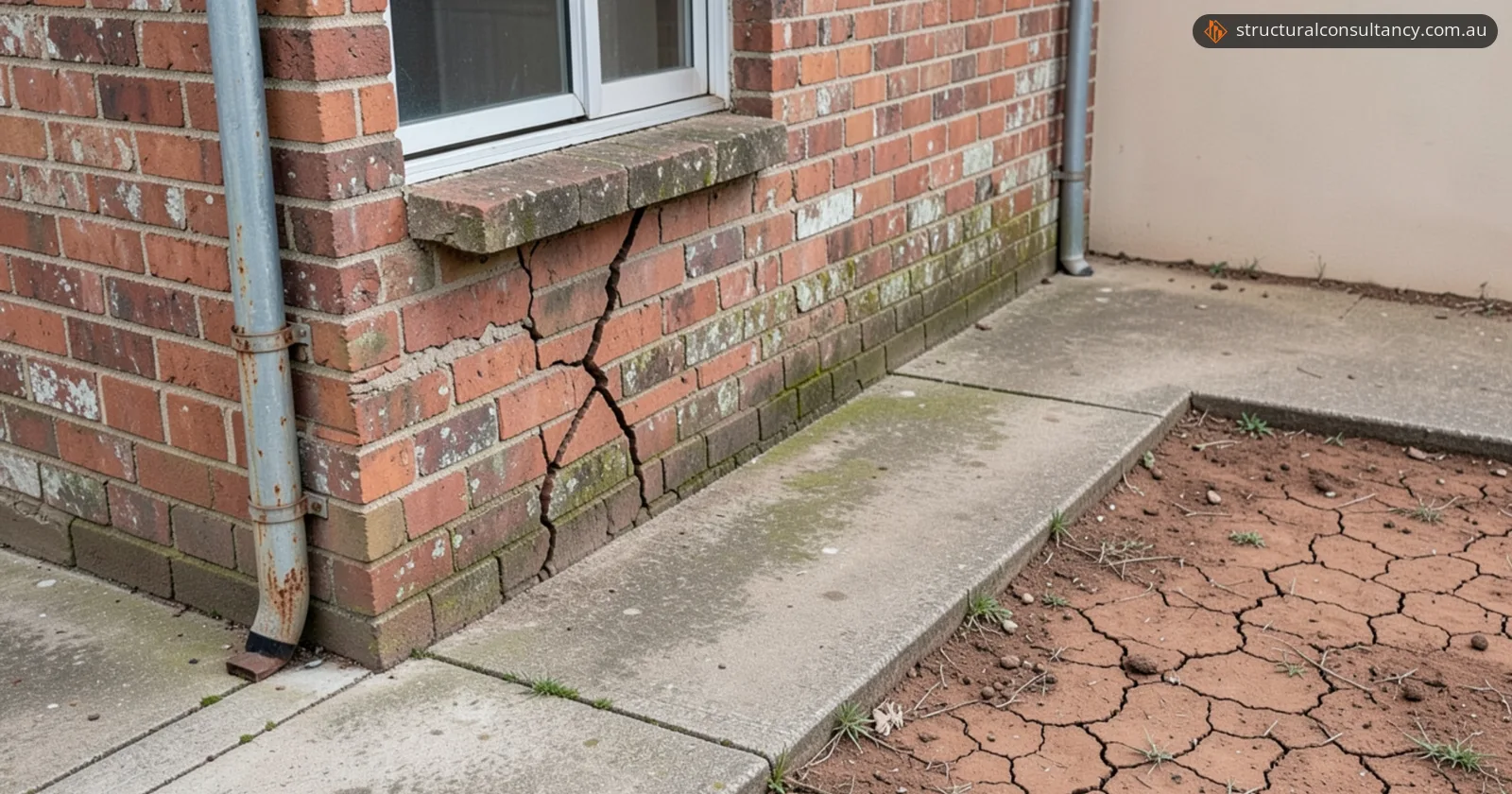
- Stepped cracks along the mortar joints of brick walls, in the body of the wall or above and below windows and doors.
- Vertical cracks through the bricks themselves.
- Doors that bind on the floor, the door head or the side of the frame.
- Cracks at the mitres of cornices.
- Floors that look dished or domed, and timber floors that feel bouncy.
- Roof hip or ridge lines that sag or bow.
- Piers under a timber floor that have lost contact with the bearers they support.
Most cracking in masonry walls is cosmetic. The damage table from AS 2870-2011, reproduced in the CSIRO guide, rates single wall cracks under 5 mm as category 2 (slight) or lower, and cracks of 5 to 15 mm, or a group of several cracks 3 mm or wider, as category 3 (moderate). Our wall cracking engineering service page explains how engineers read crack widths.
Whether a crack is growing matters too. CSIRO notes that brickwork cracks from clay swelling and shrinking can widen with each wet and dry cycle before they usually stabilise, but not always, so monitoring cracks in walls and floors should always be taken seriously.
What causes house subsidence?
House subsidence is caused by anything that changes the moisture in, or the support from, the soil under the footings. These are the causes the CSIRO guide describes:
| Cause | How it moves the footings |
|---|---|
| Clay drying out | Clay shrinks as it dries and takes support away from the footings. Shrinkage usually starts on the side of the house with the most sun. |
| Tree and shrub roots | Roots draw moisture out of the soil and shrink it. Roots growing under footings can push them up. |
| Leaking pipes and taps | Even a minuscule leak can saturate clay. Water running along backfilled pipe trenches can erode soil. |
| Roof water | Overflowing or corroded gutters, and downpipes not connected to stormwater, put water next to the footings. |
| Surface water and garden watering | Water flowing towards the house, and garden watering, can saturate the soil near footings. |
| Excavation | Digging near footings, inside the soil's angle of repose, removes their support. |
Our house drainage and stormwater drainage guides cover keeping water away from footings.
Which soils are most prone to subsidence?
Most foundation movement problems happen on clay soils. CSIRO notes that most buildings with movement problems are founded on clay, which swells and shrinks as its water content changes. Sandy soils are more prone to erosion, and even clay with about 10% sand can erode.
AS 2870-2011 groups sites into classes by how much the ground moves with moisture changes. The CSIRO guide reproduces these definitions:
| Site class | Foundation |
|---|---|
| A | Most sand and rock sites, with little or no ground movement from moisture changes |
| S | Slightly reactive clay sites |
| M | Moderately reactive clay or silt sites |
| H1 | Highly reactive clay sites (high ground movement) |
| H2 | Highly reactive clay sites (very high ground movement) |
| E | Extremely reactive sites |
A site's class generally comes from a geotechnical report. See our footings and ground slabs service.
How does a structural engineer investigate subsidence?
A structural engineer investigates subsidence by working out what is moving, by how much and why, before choosing a repair. The cause isn't always obvious. CSIRO explains that uneven soil forces twist a building, so the visible symptoms "do not simply reflect the original cause".
These are the usual steps. They follow the CSIRO guide and the order set in our crack inspection in Naremburn:
- Record the damage. Measure crack widths, mark them on a floor plan and measure floor levels against a fixed point, so later changes can be compared.
- Look for water. Check pipes, taps, gutters, downpipes and where surface water flows.
- Investigate the ground. A geotechnical investigation finds the soil type, its moisture, its bearing capacity and the depth of firm ground.
- Plan the repairs in order. Deal with the cause first, stabilise the footings next and repair the finishes last.
How is house subsidence fixed?
House subsidence is fixed by stopping the cause first, then re-supporting the footings if they have lost support, and repairing cracks last. The table compares the main fixes:
| Fix | When it's used | What it involves |
|---|---|---|
| Repair leaks and reroute pipes | Movement caused by water, sewer, stormwater or roof plumbing | Fixing the leak and, where possible, rerouting pipes and moving taps away from the house |
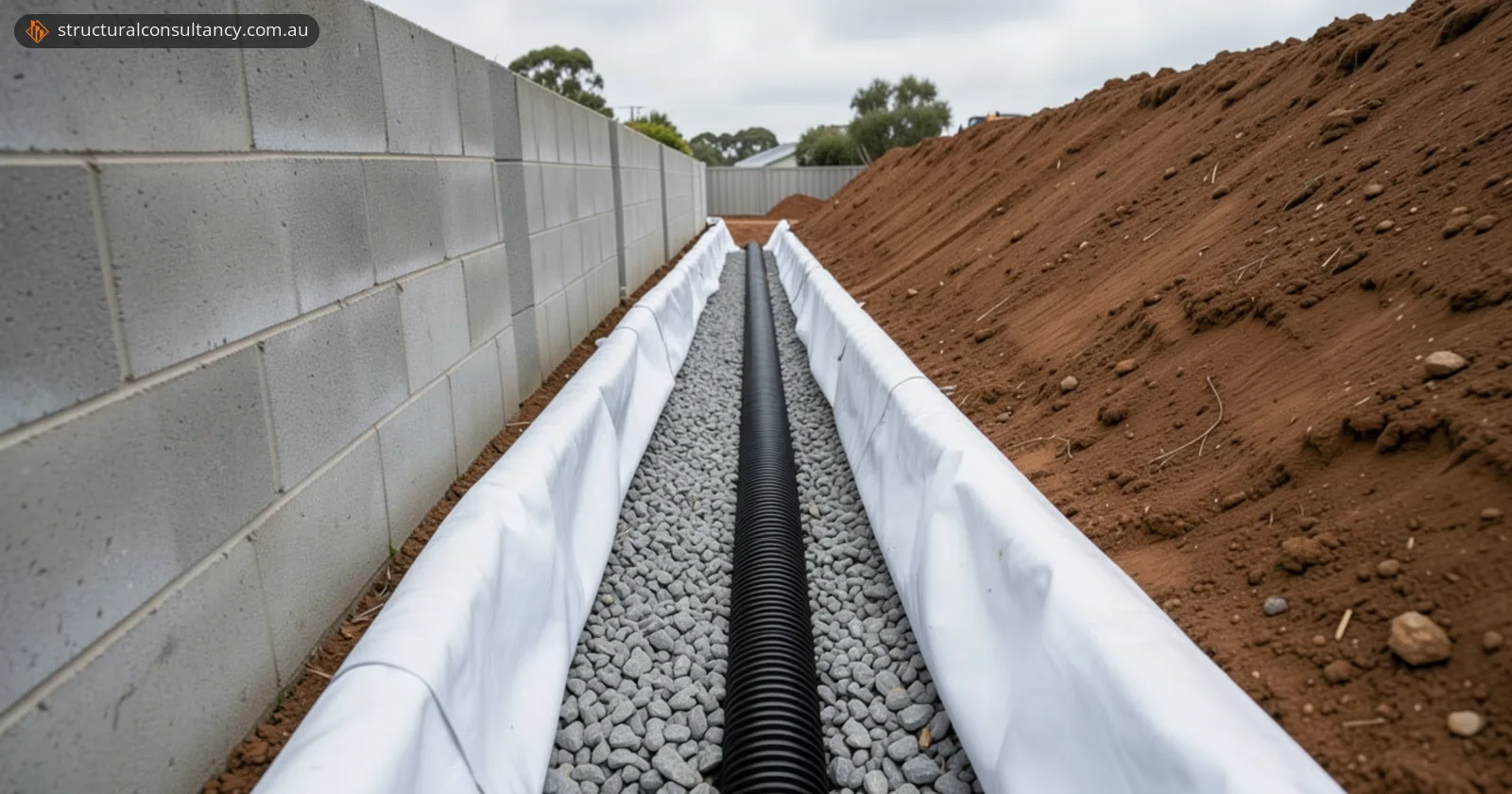
| Surface and subsoil drainage | Surface water flowing towards or under the house | A grated drain connected to the stormwater system, with subsoil drainage under it if needed |
| Paving apron around the house | Sites where moisture problems exist or are likely | Paving at least 900 mm wide (more on highly reactive soil), falling at least 1:60 away from the house and at least 100 mm below brick vent bases |
| Root barrier and tree advice | Roots under the footings or drying the soil | Cutting subsidiary roots where this won't significantly harm the tree, then a vertical concrete or metal root barrier; professional advice may be needed before removing a tree |
| Replacing eroded soil | Soil washed away beside the footings | Soil of the same classification, compacted to the same density |
| Underpinning | Footings undermined, or on ground that can't support them | A new support structure under the walls or footings, chosen to suit the soil, such as resin injection or concrete piers |
| Crack repair | After the cause is fixed and movement has stopped | Repointing, replacing broken bricks, stitching larger cracks, then plaster and paint |
What is underpinning? explains the methods in detail.
What are the subsidence rules in Sydney and NSW?
Five sets of NSW rules matter when a house is subsiding: mine subsidence districts, council tree controls, who owns the pipes, builders' warranties and contractor licences.
Mine Subsidence Districts
Subsidence Advisory NSW declares Mine Subsidence Districts where planned, active or non-active underground coal mining could cause subsidence. Districts on its list include South Campbelltown, Appin, Wilton, Picton and Bargo, plus Newcastle, Lake Macquarie, Wyong and Lithgow.
- Check an address on the NSW Planning Portal Spatial Viewer. It shows whether a property is in a district and which development guideline applies.
- Get approval before building. Building or subdividing in a district needs approval before work starts. Some minor works, such as small carports, decks and fences, don't need Subsidence Advisory approval (development approval process).
- Claim for damage. Damage from underground coal mining in NSW is claimed through Subsidence Advisory NSW's online portal, under the Coal Mine Subsidence Compensation Act 2017 (claims). A claim for a structure built without the required approval is paid only at Subsidence Advisory NSW's discretion, for example where the missing approval wasn't the owner's fault (properties in Mine Subsidence Districts).
Trees
Check your council's tree rules before cutting roots or removing a tree. Inner West Council, for example, requires a tree works permit for most trees. Council consent isn't needed to remove a tree within 1 metre of a house on the same lot, unless the tree is on Council's heritage tree list, on a heritage item property or in a Heritage Conservation Area (Inner West tree FAQs).
Leaking pipes
In Sydney Water's area, property owners own all drinking water and wastewater pipes on their side of the connection to Sydney Water's systems, so a leak there is the owner's to repair. Sydney Water may, however, repair the water pipe free of charge between its system and the meter, up to 1 metre inside your boundary (Sydney Water).
Newer homes: statutory warranties
Building Commission NSW lists foundations and footings as major elements. A defect in a major element caused by defective design, workmanship or materials is a major defect, with a 6-year statutory warranty from completion of the work. Other defects carry 2 years.
Underpinning contractors
In NSW, residential underpinning and piering work valued at more than $5,000 in labour and materials (including GST) needs a licence (NSW Government). Check the contractor's licence before work starts.
When to call a structural engineer
Call a structural engineer when cracks or distortion suggest the footings are moving, and before you spend money on repairs. Book an inspection if:
- a wall crack is 5 mm wide or more, or several cracks 3 mm or wider appear in one area, or a crack keeps getting wider;
- doors or windows have started to stick;
- floors have become dished, domed or bouncy;
- cracks come back after patching;
- a large tree near the house may need to be removed;
- you plan to build or extend in a Mine Subsidence District;
- building work on your home was completed less than 6 years ago and you suspect a footing defect.
Start with a site inspection and assessment by our structural engineers in Sydney, or our wall cracking engineering service. If the footings need re-support, see underpinning and shoring. For a newer home, a building defect report documents the problem for the builder or a complaint.
To get a quote, send photos of the cracks with a ruler for scale, your suburb, the age of the house and when you first noticed the problem. You can also call 1300 241 678.
Example from our projects
In a 1920s home in Naremburn, cracks around doors, windows and cornices, and a reported drop of about 12 mm at an internal front corner, pointed to past differential ground movement as a possible cause. Our report recommended a geotechnical investigation to confirm the underpinning method before any repair starts.
Frequently asked questions
Can subsidence start years after a house is built?
Yes. Settlement from construction usually happens in the first few months, but clay keeps shrinking and swelling with the weather, and a new leak or a growing tree can move footings later in a house's life. CSIRO notes that clay movement usually shows after prolonged dry or wet periods lasting weeks or months.
Should I pack the gap between a pier and a bearer myself?
Not without advice. CSIRO warns that extra packing can push the floor into a dome when the clay next swells, and can cause local shear failure in the soil. If packing is needed, it suggests a pair of fine wedges, checked fortnightly.
Is a house damaged by mine subsidence safe to live in?
Generally, yes. Subsidence Advisory NSW says buildings damaged by mine subsidence generally remain safe and can be used until they are repaired. After longwall mining, the ground usually settles completely within 2 to 5 years of the coal being extracted.
Sources
- CSIRO: Foundation Maintenance and Footing Performance (Building Technology Resource, 2024)
- Subsidence Advisory NSW: What is mine subsidence?
- Subsidence Advisory NSW: Mine Subsidence Districts
- Subsidence Advisory NSW: Development approval process
- Subsidence Advisory NSW: Claims
- Subsidence Advisory NSW: Properties in Mine Subsidence Districts
- Building Commission NSW: How Building Commission NSW deals with building defect complaints
- NSW Government: Underpinning and piering work
- Sydney Water: Typical system connections
- Inner West Council: Trees on your property, pruning or removing
- Inner West Council: Trees on private land FAQs