Building defects
In short: Efflorescence is the white, powdery salt left on brick, mortar, concrete or render when water carries dissolved salts to the surface and evaporates. On new brickwork it is common, usually harmless and fades with time: brush it off dry rather than hosing it. If it keeps coming back, or the masonry under it is crumbling, water may be getting in and the source needs to be found.
Key takeaways
- Efflorescence needs three things: soluble salts, too much water getting into the masonry, and evaporation that leaves the salts on the surface.
- Remove it with a stiff dry brush and collect the salt. Think Brick warns that hosing lets the salt soak back into the bricks.
- Efflorescence that keeps returning may be a warning that water is getting in, through copings, flashings, pipes or a bridged damp-proof course.
- Crumbling mortar or flaking brick faces under the salt point to salt attack, which needs both the damp and the salt treated.
- In NSW, efflorescence on new work may not be a defect by itself, but it is if failed flashings, damp-proof courses or design caused it.
Seeing white salt on your brickwork, render or concrete? Send us photos for a quote or call 1300 241 678.
What is efflorescence?
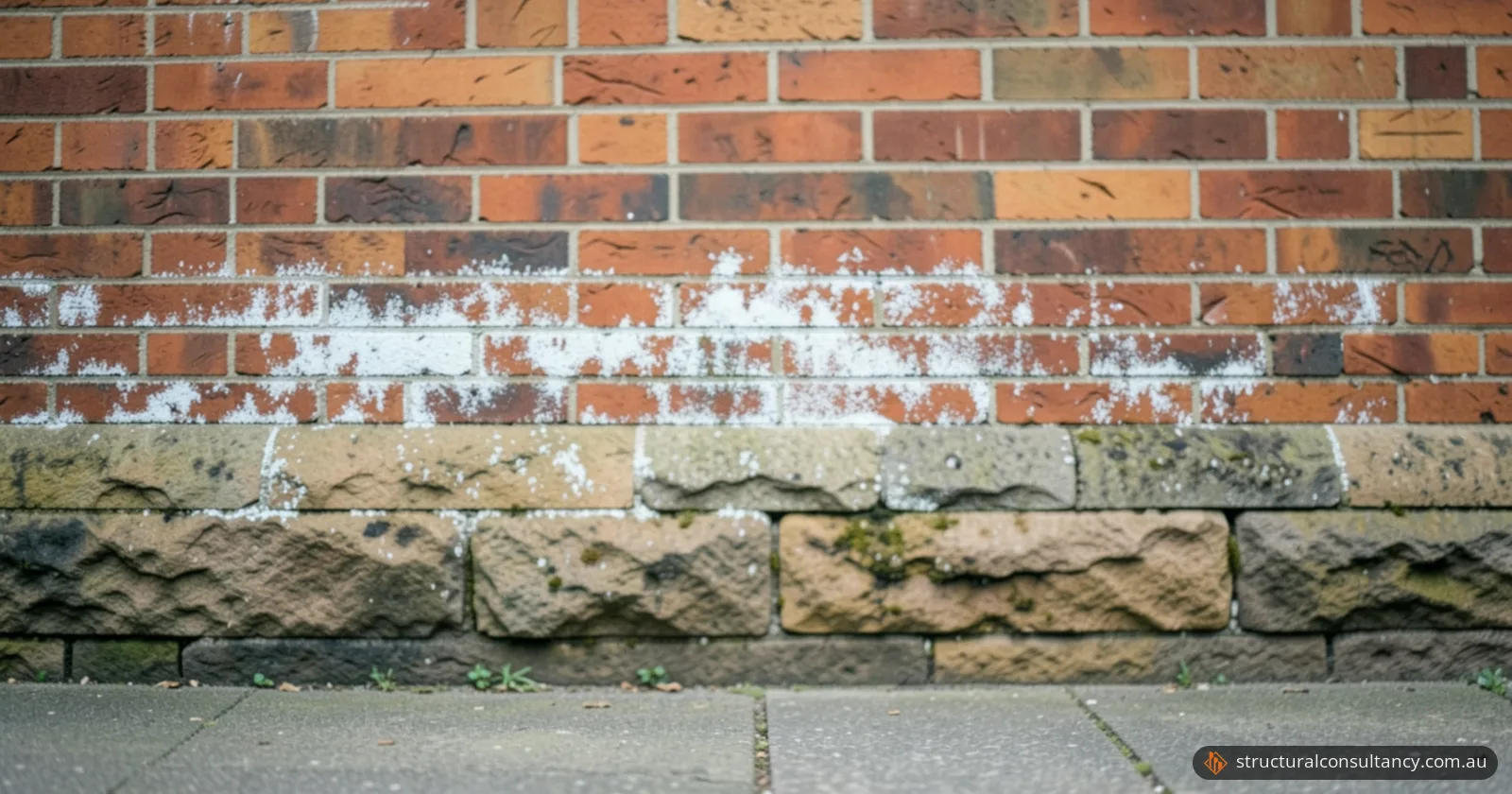
Efflorescence is a white, powdery and sometimes fluffy deposit of salts on the surface of porous materials such as brick, mortar, concrete and render. Think Brick Australia's cleaning manual says it is not a stain: the salts dissolve in water.
According to the manual, efflorescence forms when three things happen together:
- Soluble salts are present in or around the masonry.
- Too much water gets into the masonry.
- The water evaporates as the masonry dries, leaving the salts on the surface.
A temporary bloom of efflorescence is common on new brickwork.
What causes efflorescence on bricks and render?
Efflorescence on bricks is caused by water moving through the wall and carrying salt to the surface. Think Brick Australia and the NSW salt damp guide list salt sources including:
- mortar, particularly the cement in it;
- soil or fill against the wall, and salty groundwater;
- sea spray on coastal sites;
- garden fertilisers and leaking sewers;
- the bricks themselves, though the brick manual says this is not a common source.
The water usually comes from poor copings and flashings, new brickwork left uncovered in rain, rising damp, blocked or leaking gutters and downpipes, and leaking pipes. One of the first fixes the NSW guide lists is carrying rainwater well away from the base of walls; see our guide to drainage around a house.
Is efflorescence on concrete the same thing?
Efflorescence on concrete is the same process: moisture moving through the concrete dissolves salts from the cement and leaves them on the surface as it evaporates. Dulux's technical note on concrete floors says it often appears in underground car parks and other subfloor areas.
The same note says efflorescence on concrete may show that moisture is getting in from an outside source, which would be a sign of a serious problem. Continuing moisture movement can wash out soluble salts and leave weak, crumbly concrete. It may also lower the alkalinity that protects the reinforcing steel, leading to corrosion and spalling, which our concrete spalling page covers.
Is efflorescence harmful?
Efflorescence itself is usually harmless. The NSW salt damp guide describes it on new brickwork as a relatively harmless white powder, and the NSW Guide to Standards and Tolerances calls it typically non-structural apart from the discolouration.
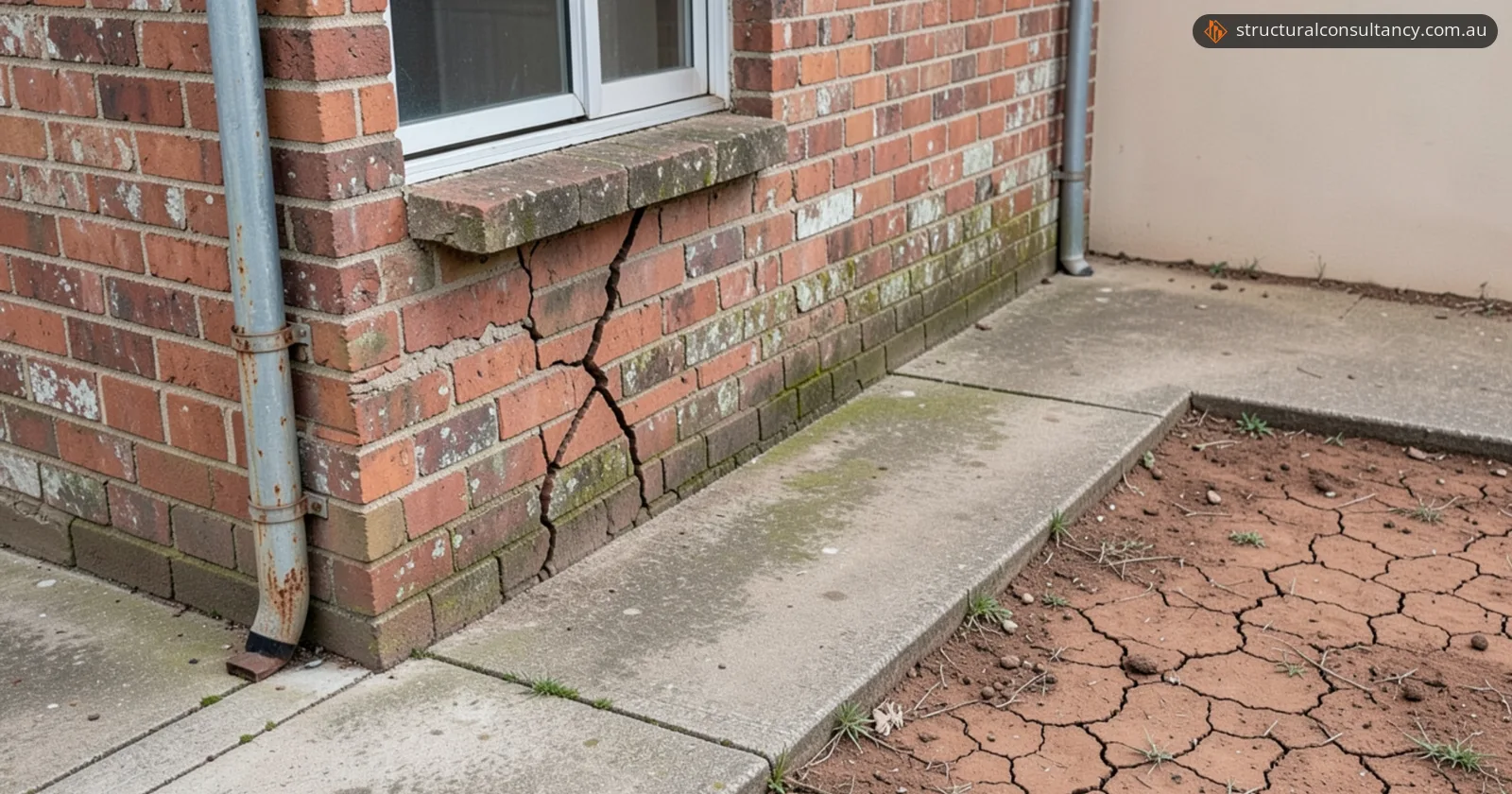
The harm comes from salt attack. When a wall dries faster, salts crystallise inside the pores instead of on the face (subflorescence). The NSW salt damp guide says the growing crystals can break up even the strongest masonry, causing crumbling mortar and the loss of a brick's hard outer fireskin. Each cycle of wetting and drying adds to the damage.
How can you tell efflorescence from salt damp, lime staining or mould?
Efflorescence is a dry, white powder on the surface that dissolves in water. Salt damp, lime staining and mould look and behave differently:
| What it is | How to recognise it | What to do first | |
|---|---|---|---|
| Efflorescence | Soluble salts left on the surface as water evaporates | White, powdery or fluffy deposit that dissolves in water | Dry-brush it and collect the salt; find the water if it returns |
| Salt attack (salt damp) | Salts crystallising inside the pores of brick, stone or mortar | Fretting and crumbling mortar, flaking brick or stone faces, often with a damp band low on the wall | Find and reduce the damp, then remove the excess salt |
| Lime (calcium) staining | Hard deposits from cement or lime in mortar, concrete or render | A milky white film that is invisible when wet and won't dissolve in water | A proprietary cleaner or diluted acid, tried on a small test area first, following the product's safety instructions, and rinsed off after |
| Mould and other organic growth | Fungi, moss and similar growth that thrive in damp conditions | Growth, not salt, common in damp, sunless spots and where masonry touches damp soil, such as flower boxes and retaining walls | Outside: brush off as much as possible with a bristle brush. Inside: find the source of the humidity, such as blocked underfloor vents |
How do you remove efflorescence from bricks?
The way to remove efflorescence from bricks is to brush it off dry and collect the salt. Think Brick Australia's cleaning manual sets out the method:
- Brush the wall with a stiff, dry brush.
- Collect the salt with a dustpan or vacuum cleaner, so it can't soak back into the brickwork or the paving below.
- Pick up any residue with a cloth wrung out until just damp, rinsing the cloth often in fresh water.
Avoid hosing the wall down. Clause 3.20 of the NSW Guide to Standards and Tolerances 2017 says efflorescence may be removed with a stiff-bristled brush and washing with water. Think Brick's manual is more cautious: it warns that rinsing brickwork only lets the salt soak back into the bricks, and it reappears when they dry. The NSW salt damp guide also notes that when masonry is washed, its suction draws some of the water inwards, taking some salt with it. So brush it off dry first, and use only a damp cloth for any residue.
On concrete, Dulux lists wire brushing, dry abrasive blasting or high-pressure water jetting, but notes that water can bring some efflorescence back.
Don't seal, paint or render over it either. Dulux says efflorescence should not be coated over, because moisture left in the material blisters the coating and pushes it off. The NSW salt damp guide warns against water-repellent coatings, and says that with hard cement render at the base of a wall, the damp eventually rises and causes decay above the render.
When does efflorescence point to a moisture or structural problem?
Efflorescence points to a real problem when it keeps coming back, sits in a band low on the walls, or comes with crumbling masonry:
| What you see | What it can point to |
|---|---|
| White powder on new brickwork that fades over time | Salts from the mortar, or from rain soaking new work: common and usually harmless |
| Efflorescence that returns after brushing | Water getting in through copings, flashings or pipes |
| A tide mark or damp band low on the wall, with salt in it | Rising damp from a missing, failed or bridged damp-proof course (DPC), or a leaking pipe |
| Crumbling mortar and flaking brick or stone faces | Salt attack (salt damp) |
| Salt on walls below a deck or balcony, or in its tile joints | Defective or missing flashings, membrane or DPC, or faulty design |
| White deposits on basement or car park concrete | Moisture getting into the concrete from outside |
The NSW salt damp guide says rising damp is often caused by bridging the DPC. It lists render over the DPC, concrete floors or paths that abut it, and paving, garden beds or built-up ground against walls, and calls build-up of paving or garden beds a common cause. It says a DPC needs to stay about 200 mm above ground or paving level to work. In Australia, rising damp normally reaches 1.0 to 1.5 metres above ground on outside walls, and the zone where it evaporates and leaves salt is commonly 0.5 to 1.2 metres up.
In cavity walls, the guide warns that salt decay can happen inside the cavity, out of sight. Wall ties corrode faster there, and the outer leaf can become structurally weak. Buildings near the coast are particularly at risk from sea spray.
What do NSW rules say about efflorescence?
In NSW, efflorescence on new work may not be a defect on its own, but its cause can be. Clause 3.20 of the NSW Guide to Standards and Tolerances 2017 says the cause must be investigated to rule out failed or missing flashings, damp-proof courses or design issues. If one of those is the cause, it is a defect. Owners' own activities, such as watering plants, may also contribute, and that part may not be the builder's responsibility.
- Decks and balconies. Clause 14.8 applies the same test to calcification and efflorescence on walls below or beside a deck or balcony, or in its tile joints.
- Damp-proof courses. Clause 3.17 says DPCs are defective if they aren't installed in accordance with the Building Code of Australia.
- Warranty periods. Building Commission NSW says homeowners have statutory warranties of 6 years for major defects and 2 years for other defects, from completion of the work. Try to resolve the matter with the builder first. The owner must apply to the NSW Civil and Administrative Tribunal (NCAT) before the warranty period ends. If a breach is found in the last 6 months of the period, homeowners have an extra 6 months after it ends to start proceedings.
Efflorescence and salt damp in Sydney
Sydney's climate slows salt damp down but doesn't stop it. The NSW salt damp guide says Sydney's more humid climate and lower salt levels mean slower decay than in Adelaide, but a building with a mild damp problem can build up enough salt over time to cause major decay.
- Older terraces and cottages. Many nineteenth-century Australian buildings were built without a DPC, and early ones used slate, lead or a hot-laid tar and sand mix. The guide says an old tar and sand DPC shouldn't be assumed defective just because it is old.
- Western Sydney. The NSW Government's urban salinity booklet says salinity hazard is widespread and variable across western Sydney, and lists efflorescence and tide marks on walls among the signs in buildings.
- Near the coast and on salty ground. Sea spray adds salt to walls. For new work on salty ground, the NSW Building in a Saline Environment booklet (2008) points to exposure grade bricks below the DPC, and names the Australian test for a brick's potential to effloresce, AS/NZS 4456.6. PGH recommends exposure grade bricks within 1 km of a surf coast or 100 m of a non-surf coast.
When to call a structural engineer
Call a structural engineer when efflorescence is a symptom rather than a one-off. Book an inspection if:
- it keeps coming back after brushing and a dry spell;
- mortar is crumbling, brick or stone faces are flaking, or nearby concrete is spalling;
- there's a tide mark low on the walls, or paving or garden beds sit above the damp-proof course;
- salt is showing below a balcony or deck, or the house is new and you suspect a failed flashing, membrane or damp-proof course.
The NSW salt damp guide recommends independent advice before paying for damp-proofing, because many contractors specialise in one treatment only. It says an investigation should cover the walls inside and out, stormwater drainage, paving against the walls, the damp-proof courses, the wall cavities and the underfloor ventilation. On reactive clay soils, drying the ground too much can cause structural cracking, so the fix has to balance damp against movement.
A building defect report records the cause, which matters when a builder's warranty may apply. For salt damage in older walls, see our remedial engineering service or book a site inspection. Owners corporations dealing with salt under balconies can start with our strata reports.
Example from our projects
In our crack inspection of a 1920s home in Naremburn, the report listed past water ingress, which may have changed the ground support, as one of the possible causes of the cracking. It put a ground investigation ahead of any masonry and plaster repairs.
Have white salt on your walls? Send us photos of the affected areas, inside and out, with a short description, and we'll tell you what the inspection would involve: get a quote.
Frequently asked questions
Will efflorescence go away by itself?
Usually, on new brickwork. Think Brick Australia says most efflorescence naturally disappears over time. If it keeps coming back, water may still be getting into the wall, or the salt source is still active, as PGH notes.
Why does efflorescence often appear after rain?
Rain soaks into porous masonry and dissolves the salts in it, and as the wall dries the salts are left on the face. The NSW salt damp guide also notes that rain can wash salts back into walls and hide them, so walls are best inspected before and after a dry spell.
How can efflorescence be prevented on new brickwork?
Keep water out while the wall is built. Think Brick Australia lists rain on unprotected new brickwork and bricks stored where they soak up ground salts and water as common causes. On salty sites, NSW guidance suggests choosing bricks with a low salt content, tested under AS/NZS 4456.6.
Does efflorescence mean the bricks are poor quality?
Not usually. Think Brick Australia says the bricks themselves are not a common source of the salt; mortar, soil and sea spray are more often to blame. Brick quality matters more for salt attack, where the NSW salt damp guide notes that paler, underfired bricks are more susceptible than darker, well-fired ones.
Sources
- Heritage Council of NSW and others: Salt attack and rising damp, a guide to salt damp in historic and older buildings (2008)
- NSW Fair Trading: NSW Guide to Standards and Tolerances 2017
- Think Brick Australia: Manual 13, Clay Masonry Cleaning Manual
- Building Commission NSW: How building defect complaints are dealt with
- NSW Department of Natural Resources: Introduction to urban salinity (2006)
- NSW Department of Environment and Climate Change: Building in a Saline Environment (2008)
- Standards Australia: AS/NZS 4456.6:2003, Determining potential to effloresce
- Dulux Protective Coatings: Tech Note 1.3.4, Concrete floors, efflorescence
- PGH Bricks: Frequently asked questions